Collections Framework
The Java Collections Framework (JCF) is a unified architecture that provides ready-made, high-performance data structures — lists, sets, maps, queues, and more — along with the algorithms that operate on them. Instead of reinventing the wheel every time you need to store or process a group of objects, you pick the right collection for the job and get production-quality behaviour for free.
Note: The Collections Framework lives in the
java.utilpackage. Most classes and interfaces you’ll use are right there — no extra dependency needed.
Why Collections?
Before the Collections Framework (introduced in Java 1.2), Java developers had to use plain arrays or the outdated Vector/Hashtable classes. Arrays are fixed-size and lack built-in search or sort helpers. The JCF solved both problems and added a consistent API across every data structure.
Key benefits at a glance:
| Without JCF | With JCF |
|---|---|
| Fixed-size arrays | Dynamically sized structures |
| Manual resize/copy code | Handled automatically |
| No shared contract | Unified interfaces (List, Set, Map, …) |
| Ad-hoc algorithms | Built-in sort, search, shuffle via Collections |
| Thread safety — your problem | Concurrent variants provided |
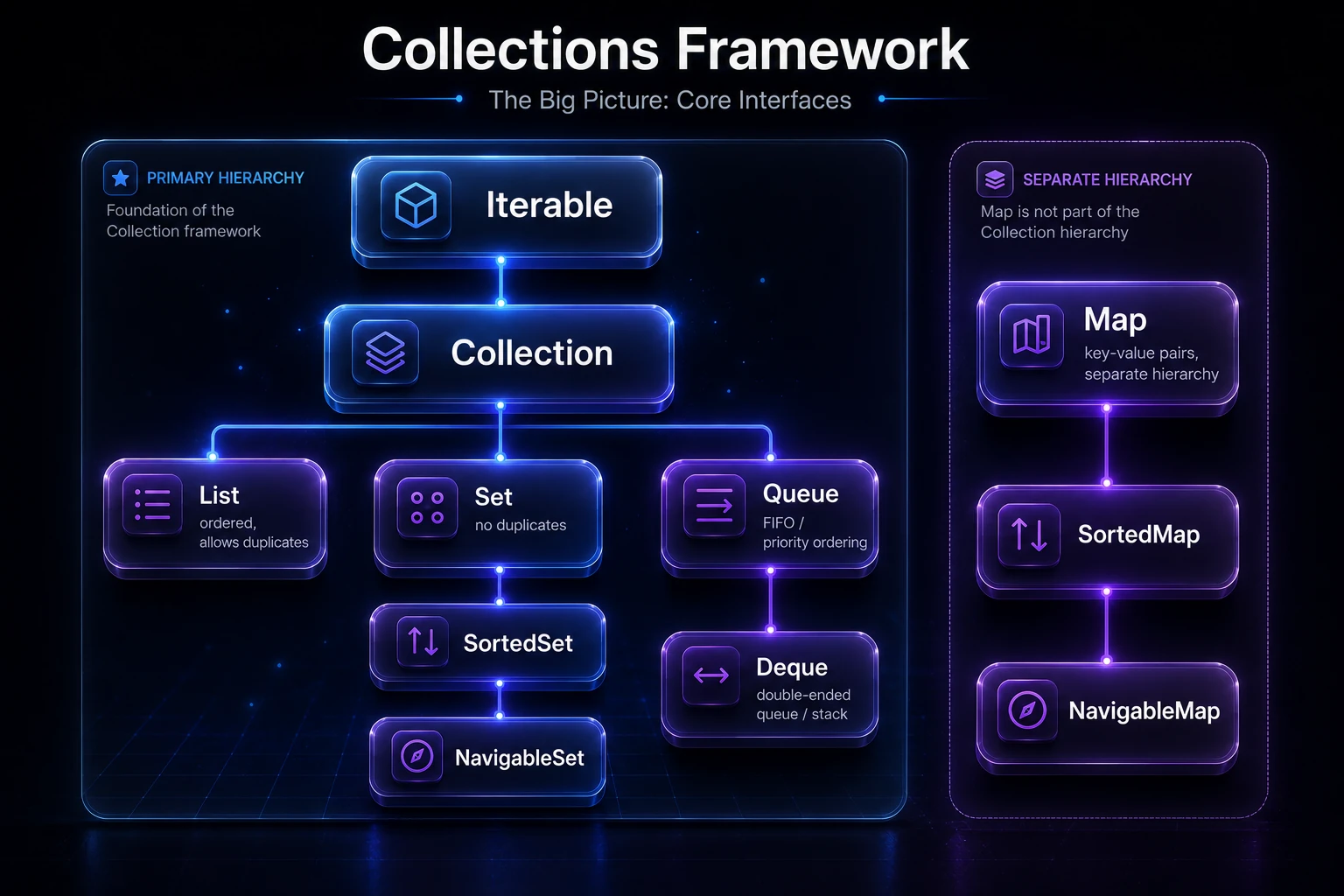
The Big Picture: Core Interfaces
The framework is built around a small set of interfaces. Understanding the hierarchy is the key to choosing the right type.
Iterable
  └── Collection
        ├── List        (ordered, allows duplicates)
        ├── Set         (no duplicates)
        │     └── SortedSet → NavigableSet
        └── Queue       (FIFO / priority ordering)
              └── Deque (double-ended queue / stack)

Map                     (key-value pairs, separate hierarchy)
└── SortedMap → NavigableMapList— You care about order and position. Duplicates are fine.Set— You care only about membership. No duplicates allowed.Queue/Deque— You process elements in a specific order (FIFO, LIFO, priority).Map— You look things up by a unique key.
A Quick Taste
Here is a short example that touches several core types so you can see how consistent the API feels:
import java.util.*;

public class CollectionsOverview {
    public static void main(String[] args) {
        // List — ordered, indexed, duplicates allowed
        List<String> languages = new ArrayList<>();
        languages.add("Java");
        languages.add("Python");
        languages.add("Java"); // duplicate is fine
        System.out.println("List: " + languages);

        // Set — no duplicates
        Set<String> unique = new HashSet<>(languages);
        System.out.println("Set: " + unique);

        // Map — key → value
        Map<String, Integer> scores = new HashMap<>();
        scores.put("Alice", 95);
        scores.put("Bob", 87);
        System.out.println("Map: " + scores);

        // Queue — FIFO
        Queue<String> queue = new LinkedList<>();
        queue.offer("first");
        queue.offer("second");
        System.out.println("Poll: " + queue.poll());
    }
}
Output:
List: [Java, Python, Java]
Set: [Java, Python]
Map: {Alice=95, Bob=87}
Poll: first
Choosing the Right Collection
This decision table covers the most common choices:
| Need | Best Choice |
|---|---|
| Fast random access by index | ArrayList |
| Frequent insert/delete in the middle | LinkedList |
| Fast membership test, no order needed | HashSet |
| Membership test + insertion order | LinkedHashSet |
| Sorted unique elements | TreeSet |
| Key→value lookup, no order | HashMap |
| Key→value + insertion order | LinkedHashMap |
| Key→value + sorted keys | TreeMap |
| FIFO queue | ArrayDeque |
| Priority-based processing | PriorityQueue |
| Thread-safe list | CopyOnWriteArrayList |
| Thread-safe map | ConcurrentHashMap |
Tip: When you only know you need a
List, declare the variable asList<String>(the interface), notArrayList<String>. This makes it trivial to swap the implementation later without touching calling code.
Generics and Type Safety
All modern collection classes are generic. You parameterise them with a type in angle brackets (<>), and the compiler enforces that you only put the right type of objects in:
List<Integer> numbers = new ArrayList<>();
numbers.add(42);
numbers.add(7);
// numbers.add("hello"); // compile error — caught at compile time, not runtime
int sum = numbers.get(0) + numbers.get(1);
System.out.println(sum); // 49
Without generics (pre-Java 5), everything was stored as Object and you had to cast — a common source of ClassCastException at runtime. See Generics for the full story.
Iterating Over Collections
Every Collection implements Iterable, so you can use the for-each loop directly:
List<String> cities = List.of("London", "Tokyo", "Nairobi");
for (String city : cities) {
    System.out.println(city);
}
For more control — like removing elements while iterating — use an explicit Iterator:
List<Integer> nums = new ArrayList<>(Arrays.asList(1, 2, 3, 4, 5));
Iterator<Integer> it = nums.iterator();
while (it.hasNext()) {
    if (it.next() % 2 == 0) {
        it.remove(); // safe removal during iteration
    }
}
System.out.println(nums); // [1, 3, 5]
Warning: Never modify a collection directly (e.g.
list.remove(...)) while iterating over it with a for-each loop — you’ll get aConcurrentModificationException. UseIterator.remove()or aremoveIf()call instead.
Under the Hood
Fail-Fast Iterators
Most JDK collections maintain an internal modCount counter that increments on every structural change (add, remove, clear). When an iterator is created, it snapshots this value. On each next() call, it compares the current modCount against its snapshot — if they differ, it throws ConcurrentModificationException immediately. This “fail-fast” design surfaces bugs early rather than silently returning garbage data.
Memory Layout
ArrayListandArrayDequeback their elements in a contiguousObject[]. This gives CPU-cache-friendly access — iterating is very fast because adjacent elements sit in adjacent memory locations.LinkedList,HashMap,TreeMapuse heap-allocated node objects with pointer fields, which means more memory overhead and less cache locality.HashMapstores entries in an array of buckets. Since Java 8, each bucket can hold a red-black tree (instead of a plain linked list) once it reaches 8 entries, keeping worst-case lookup at O(log n) rather than O(n).
Performance Complexity (Common Operations)
| Operation | ArrayList | LinkedList | HashSet/HashMap | TreeSet/TreeMap |
|---|---|---|---|---|
| get(index) | O(1) | O(n) | — | — |
| add (end) | O(1) amortised | O(1) | O(1) avg | O(log n) |
| add (middle) | O(n) | O(1)* | — | — |
| contains | O(n) | O(n) | O(1) avg | O(log n) |
| remove | O(n) | O(1)* | O(1) avg | O(log n) |
* After you already hold the node reference; finding the node is O(n).
Unmodifiable and Immutable Views
Java 9+ factory methods (List.of(...), Set.of(...), Map.of(...)) return truly immutable collections — attempting to call add or put throws UnsupportedOperationException. They are also more memory-efficient than wrapping with Collections.unmodifiableList(...) because the JDK uses compact internal representations.
List<String> immutable = List.of("a", "b", "c");
// immutable.add("d"); // throws UnsupportedOperationException
In This Section
- Collection Interface — The root interface shared by List, Set, and Queue; learn the core contract every collection must honour.
- List Interface — Ordered, index-based sequences that allow duplicate elements; the most-used collection type in everyday Java.
- ArrayList — The go-to resizable array implementation of List with O(1) random access and amortised O(1) appends.
- LinkedList — A doubly-linked list that also implements Deque; ideal when you need frequent insertions or removals at both ends.
- ArrayList vs LinkedList — A head-to-head comparison of time complexity, memory, and practical use cases to help you pick the right one.
- Vector — The legacy thread-safe list from Java 1.0; understand when (rarely) it’s still appropriate.
- ArrayList vs Vector — Why ArrayList replaced Vector for almost all use cases, and when the old class still appears in codebases.
- Stack — LIFO stack built on Vector; learn its API and why
ArrayDequeis usually preferred in modern code. - Set Interface — A collection that guarantees no duplicate elements; the contract shared by HashSet, LinkedHashSet, and TreeSet.
- HashSet — The fastest general-purpose Set backed by a HashMap; O(1) average add/contains/remove.
- LinkedHashSet — A HashSet that remembers insertion order, giving you uniqueness without losing sequence.
- TreeSet — A sorted Set backed by a red-black tree; elements are always in natural or comparator order.
- Queue & PriorityQueue — FIFO queues and heap-backed priority queues for task scheduling and ordered processing.
- Deque & ArrayDeque — A double-ended queue that outperforms both Stack and LinkedList for stack/queue workloads.
- Map Interface — The contract for key-value stores; understand the methods every Map must provide.
- HashMap — The workhorse key-value store with O(1) average lookup; learn its bucket, load-factor, and resize mechanics.
- Working of HashMap (Internals) — A deep dive into hashing, bucket arrays, linked-list-to-tree treeification, and Java 8 improvements.
- LinkedHashMap — A HashMap that preserves insertion (or access) order; great for LRU caches.
- TreeMap — A sorted Map backed by a red-black tree; supports range queries like
subMap,headMap, andtailMap. - Hashtable — The original synchronised map from Java 1.0; understand its limitations and why HashMap or ConcurrentHashMap is preferred.
- HashMap vs Hashtable — Synchronisation, null handling, and performance differences explained side-by-side.
- Iterator — The standard cursor for traversing any collection safely, including safe removal during iteration.
- Comparable — How to give your objects a natural ordering by implementing
compareTo. - Comparator — How to define external, reusable ordering strategies, especially useful with Java 8 lambda syntax.
- Comparable vs Comparator — When to bake ordering into the class vs. when to supply it from the outside.
- Collections Utility Class — The static helper methods
sort,shuffle,reverse,binarySearch,frequency, and more. - Sorting Collections — How to sort Lists with natural order, Comparators, and the Stream API.
- Properties Class — A specialised Map for string key-value pairs, commonly used for configuration files.
- EnumSet & EnumMap — Ultra-efficient set and map implementations purpose-built for enum constants.
- Concurrent Collections — Thread-safe structures like
ConcurrentHashMap,CopyOnWriteArrayList, and blocking queues for multi-threaded code.
Related Topics
- Generics — Collections are generic; understanding type parameters makes the whole framework click.
- Iterators — Learn the cursor that powers every for-each loop under the hood.
- Stream API — Process collections with filter, map, and reduce using a functional pipeline.
- Sorting Collections — Practical patterns for sorting Lists and Maps in modern Java.
- Concurrent Collections — The thread-safe variants you need when multiple threads share data.
- Arrays Utility Class — The
java.util.Arrayscounterpart for fixed-size array operations.