Java Project Ideas
The best way to grow as a Java developer is to build things. Reading tutorials and studying syntax is a solid foundation, but real understanding comes from sitting down, designing something from scratch, and wrestling with the edge cases nobody warns you about. This section gives you a structured menu of project ideas — organized by difficulty — plus the guidance you need to actually finish them.
Why Build Projects?
Projects force you to connect concepts you learned in isolation. You don’t just know what a HashMap is — you use one, realize the iteration order isn’t what you expected, and reach for a LinkedHashMap instead. That moment of friction is worth a hundred flashcard reviews.
Building projects also gives you:
- A portfolio to show employers or clients
- Practice with Java’s standard library in realistic contexts
- Exposure to the design decisions that separate “working code” from “good code”
- A reason to explore topics like design patterns, exception handling, and multithreading
Tip: Don’t wait until you feel “ready.” Pick something one step above your comfort level and start. You’ll learn faster by doing than by preparing to do.
How to Pick a Project
Ask yourself three questions:
- What can I already build? — Choose a domain you understand well enough to define the requirements (a simple game, a grade calculator, a personal budget tracker).
- What do I want to learn next? — Use the project as a forcing function. Want to understand file I/O? Build a note-taking app that reads and writes
.txtfiles. - How long can I realistically spend? — A weekend project has different scope than a month-long portfolio piece. Be honest and start small.
Beginner Projects (0–6 months)
These projects rely on the fundamentals: variables, control statements, methods, arrays, and basic OOP concepts.
1. Number Guessing Game
The computer picks a random number; the user guesses until they get it. Teaches loops, conditionals, and user input via Scanner.
import java.util.Scanner;
import java.util.Random;

public class GuessingGame {
    public static void main(String[] args) {
        Random rand = new Random();
        int secret = rand.nextInt(100) + 1;
        Scanner sc = new Scanner(System.in);
        int guess = 0;
        int attempts = 0;

        System.out.println("Guess a number between 1 and 100:");

        while (guess != secret) {
            guess = sc.nextInt();
            attempts++;
            if (guess < secret) System.out.println("Too low! Try again:");
            else if (guess > secret) System.out.println("Too high! Try again:");
        }
        System.out.println("Correct! It took you " + attempts + " attempt(s).");
        sc.close();
    }
}
2. Student Grade Calculator
Accept marks for multiple subjects, calculate the average, and assign a letter grade. Great for practicing arrays and methods.
public class GradeCalculator {

    public static char letterGrade(double avg) {
        if (avg >= 90) return 'A';
        else if (avg >= 80) return 'B';
        else if (avg >= 70) return 'C';
        else if (avg >= 60) return 'D';
        else return 'F';
    }

    public static void main(String[] args) {
        int[] marks = {85, 92, 78, 95, 88};
        int sum = 0;
        for (int m : marks) sum += m;
        double avg = (double) sum / marks.length;
        System.out.printf("Average: %.2f  Grade: %c%n", avg, letterGrade(avg));
    }
}
Output:
Average: 87.60 Grade: B3. Simple To-Do List (Console)
Add, remove, and display tasks stored in an ArrayList. A natural introduction to the Collections Framework.
4. ATM Simulator
Model a bank account with encapsulation: private balance, deposit, withdraw, and balance-check methods. Add a PIN check for authentication.
5. Temperature Converter
Convert between Celsius, Fahrenheit, and Kelvin. Small scope, but excellent for practicing method overloading and static utility design.
Intermediate Projects (6 months – 2 years)
These push you toward inheritance, interfaces, exception handling, file I/O, and the Collections Framework.
6. Library Management System
Model books, members, and checkouts. Use inheritance (PhysicalBook and EBook extend Book), ArrayList for the catalogue, and file handling to persist data between runs.
Key concepts exercised:
- Polymorphism — treat all book types uniformly
- Custom exceptions —
BookNotAvailableException - Serialization — save and load catalogue state
7. Console-Based Bank Application
Extend the ATM simulator into a multi-account system. Store accounts in a HashMap keyed by account number. Support transfers between accounts.
import java.util.HashMap;
import java.util.Map;

public class Bank {
    private Map<String, Double> accounts = new HashMap<>();

    public void createAccount(String id, double initialBalance) {
        accounts.put(id, initialBalance);
    }

    public void transfer(String from, String to, double amount) {
        double fromBalance = accounts.getOrDefault(from, 0.0);
        if (fromBalance < amount) throw new IllegalArgumentException("Insufficient funds");
        accounts.put(from, fromBalance - amount);
        accounts.merge(to, amount, Double::sum);
    }

    public double balance(String id) {
        return accounts.getOrDefault(id, 0.0);
    }
}
8. Student Record System with File Persistence
Store student records (name, ID, grades) in a file. Read on startup, write on exit. Use BufferedReader and BufferedWriter for efficient I/O, or object streams with Serialization to store the full object graph.
9. Text-Based RPG (Role Playing Game)
A classic learning project. Characters have health, attack, and defense stats. Enemies follow strategies. Combat runs in a loop. This naturally exercises:
- Inheritance and abstract classes
- Interfaces for things like
CombatantorLootable - Enums for character classes and item types
- Recursion for dungeon traversal
10. Multithreaded File Downloader
Simulate downloading multiple files in parallel using Thread Pools and Callable & Future. Display progress in the console. Introduces real concurrency challenges.
import java.util.concurrent.*;

public class FakeDownloader {
    public static void main(String[] args) throws Exception {
        ExecutorService pool = Executors.newFixedThreadPool(3);
        String[] files = {"report.pdf", "image.png", "data.csv"};

        for (String file : files) {
            pool.submit(() -> {
                System.out.println(Thread.currentThread().getName() + " downloading " + file);
                Thread.sleep(1000); // simulate work
                System.out.println("Done: " + file);
                return null;
            });
        }
        pool.shutdown();
        pool.awaitTermination(10, TimeUnit.SECONDS);
    }
}
Note: Real file downloads use
HttpURLConnectionor the newerjava.net.http.HttpClient(Java 11+). See HttpURLConnection for details.
Advanced Projects (2+ years)
These projects integrate multiple Java subsystems and prepare you for professional work.
11. Chat Application (TCP Sockets)
Build a server that handles multiple clients using socket programming and a thread-per-client model (or a thread pool). Clients connect, send messages, and receive broadcasts. Teaches real networking and concurrency under one roof.
12. Mini Database Engine
Implement an in-memory table store with insert, select, and delete operations. Back it with a file (append-only log, compacted periodically). You’ll touch serialization, NIO.2, generics, and—if you add query parsing—regular expressions.
13. Web Scraper / News Aggregator
Fetch HTML from news sites using HttpURLConnection or HttpClient, parse headlines, and store results in a TreeMap by date. Schedule periodic runs with a ScheduledExecutorService. Add Base64 encoding if you cache images.
14. Java JDBC CRUD Application
Connect to a real MySQL or PostgreSQL database with JDBC. Implement full create/read/update/delete for an entity (e.g., products or employees). Use PreparedStatement to prevent SQL injection, and transaction management to keep data consistent.
15. Design-Pattern Showcase
Not a single app, but a structured collection of mini-programs demonstrating the Gang of Four patterns in Java. See the Design Patterns page in this section for a full breakdown.
Project Structure Tips
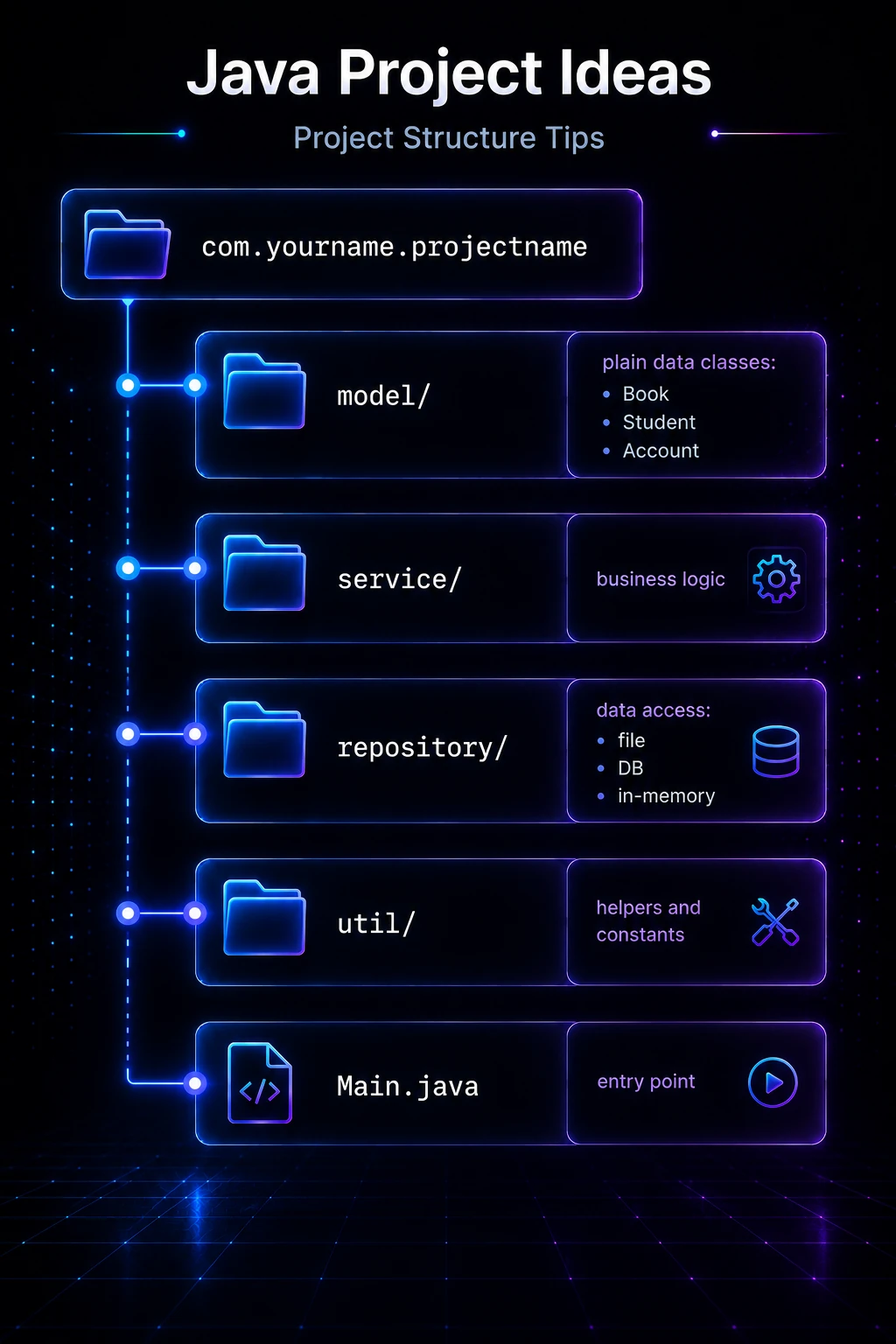
When your project grows beyond a single file, structure matters. Follow Java naming conventions and organize code into packages:
com.yourname.projectname
├── model/       ← plain data classes (Book, Student, Account)
├── service/     ← business logic
├── repository/  ← data access (file, DB, in-memory)
├── util/        ← helpers and constants
└── Main.java    ← entry point
Keeping layers separate makes the code easier to test and extend — and it mirrors the architecture you’ll see in real-world Java applications.
Tip: Even if you’re building a console app, practicing this layered structure now means Spring Boot, Jakarta EE, or any framework will feel familiar when you reach them.
Quick Project-to-Concept Mapping
| Project | Key Concepts |
|---|---|
| Number Guessing Game | Loops, Scanner, Random |
| Grade Calculator | Arrays, Methods, Math |
| Library Management | Inheritance, Polymorphism, File I/O |
| Bank Application | HashMap, Exception Handling, Encapsulation |
| Multithreaded Downloader | Thread Pool, Callable, Future |
| Chat Application | Sockets, Threads, I/O Streams |
| JDBC CRUD App | JDBC, PreparedStatement, Transactions |
In This Section
- Design Patterns — Learn the classic Gang of Four patterns (Singleton, Factory, Observer, Strategy, and more) implemented in idiomatic Java with real-world context.
Related Topics
- Design Patterns — apply proven structural solutions to the problems your projects will inevitably encounter
- Exception Handling — every real project needs a solid strategy for errors and edge cases
- Collections Framework — the data structures that power virtually every non-trivial Java application
- Multithreading — add concurrency to your projects once the single-threaded version works
- JDBC — connect your projects to a real database for persistent, queryable storage
- Clean Code in Java — habits that keep your project code readable and maintainable as it grows